
Search Arkansas Residents Directory
The Arkansas Residents Directory pulls together the public records that help you find a person across the state. You can look up a name, check a court case, trace a property owner, or pull a marriage record from any of the 75 Arkansas counties. Most of what you need sits with the County Clerk, Circuit Clerk, Assessor, or the state's CourtConnect system. This site shows you where each piece of resident data lives, who keeps it, and how to get it. Use the directory to start your search by county, by city, or by state agency.
Arkansas Residents Directory at a Glance
How to Use the Arkansas Residents Directory
The Arkansas Residents Directory is a starting point, not a single database. Public information about people in Arkansas sits in many places. Some of it lives at the state level, like court case data and the sex offender registry. Most of it sits at the county level, kept by the County Clerk, the Circuit Clerk, the Assessor, and the Sheriff. The directory points you to each office and tells you what you can pull from each one.
Pick a county or city page from this site to find the local offices that keep resident records for that area. The county pages list the Circuit Clerk for court files, the Assessor for property data, the Sheriff for arrest and inmate info, and the County Clerk for voter rolls and marriage licenses. City pages show which county handles filings for that town and where the local police records live. The Arkansas Public Information Act backs the public's right to most of this data under Act 152 of 1999.
The Residents Directory works best when you know what you're looking for. A name search at CourtConnect turns up court history. A property search at the county Assessor turns up a home address tied to an owner's name. A marriage record at the County Clerk shows family ties. Combine these sources and you build a full picture of an Arkansas resident from public data alone.
Note: Most resident records in the Arkansas Residents Directory are free to view, though paper or certified copies often carry a small fee.
Court Records in the Residents Directory
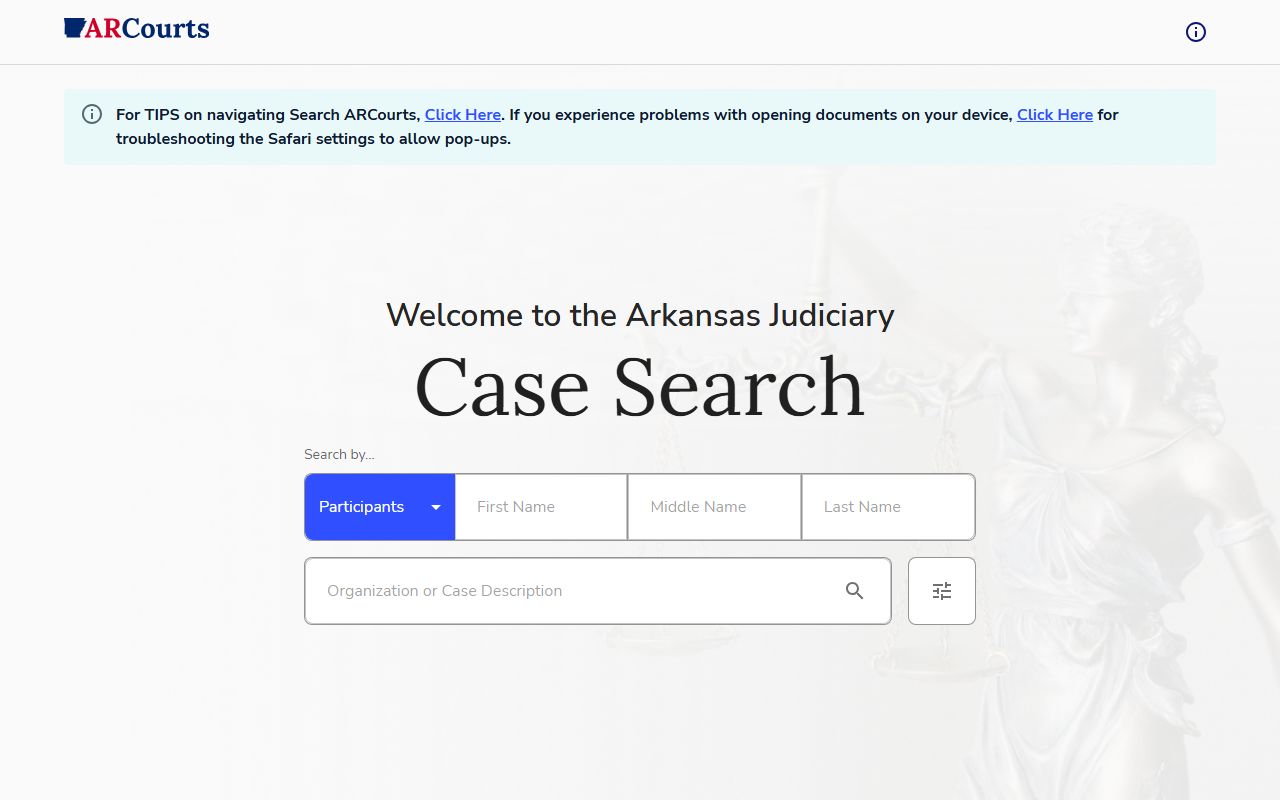
Court files are one of the most useful slices of the Arkansas Residents Directory. The Arkansas Judiciary runs a free statewide portal called CourtConnect. It covers civil, criminal, probate, domestic relations, and juvenile cases from all 28 circuit court districts across the state's 75 counties. You can search by participant name, case number, or attorney bar number.
The CourtConnect tool shown below from caseinfo.arcourts.gov is the front door for most court-based name searches. The system is open 24/7 except during scheduled maintenance windows. Results show case type, judge, file date, party names, docket entries, and current status.
CourtConnect pairs well with the appellate-level search at the Arkansas Supreme Court and Court of Appeals site. The Supreme Court has seven justices on eight-year terms; the Court of Appeals has twelve judges on the same eight-year terms. Opinions go up the day they are issued, and the case search lets you track an appeal by name or case number. For people researching a resident in the directory, appellate filings can flag long-running disputes that started in a circuit court.
Some Arkansas counties also keep their own court search tools. Pulaski, Sebastian, Benton, and Washington run dashboards that go deeper than CourtConnect for local cases. Check the county page on this site to find direct links to those local court portals.
County Records and the Arkansas Residents Directory
Each of the 75 Arkansas counties keeps its own slice of the Residents Directory. The Circuit Clerk holds court files and acts as the County Recorder for deeds, mortgages, liens, plat maps, and powers of attorney. The Assessor keeps property records, parcel maps, and ownership data. The Collector handles tax payments. The Sheriff runs the jail and keeps arrest and incident reports. The County Clerk runs voter registration and marriage licenses.
Office hours and fees shift a bit from county to county. Most Circuit Clerk offices run Monday through Friday, 8:00 AM to 4:30 PM. Recording fees follow state statute at $15 for the first page and $5 for each extra page. Marriage licenses cost about $60 and need both parties present with valid ID. Some counties have a single courthouse; others have two seats and split records by district.
A few examples show the range. Pulaski County Clerk Terri Hollingsworth's office in Little Rock offers online services for marriage licenses, small estate affidavits, court case lookups, real estate document recording, absentee ballot requests, voter registration, and DBA searches. Benton County in Bentonville runs a comprehensive GIS mapping system and accepts e-recordings for land documents. Sebastian County in Fort Smith covers tee-time bookings at county golf courses, child support services, sex offender watch, and warrant searches alongside its court and property records.
Browse the full list of county pages to find the right office for the resident you are looking up. Each page lists the courthouse address, phone, hours, and direct links to that county's online resources.
Vital Records and the Arkansas Residents Directory
Vital records are the foundation of the Arkansas Residents Directory. Births, deaths, marriages, and divorces all leave a paper trail that anyone can pull with the right paperwork. The Arkansas Department of Health Vital Records office at 4815 W. Markham Street in Little Rock keeps the statewide index. Birth certificates cost $12 for the first copy and $10 for each extra. Death certificates run $10 per copy. Marriage and divorce records cost $10 per copy through ADH.
You need a valid photo ID and a direct interest in the record to get a certified copy from the state. Immediate family, a legal rep, or someone with a court order all qualify. Birth records open to the public after 100 years. Death and marriage records open after 50 years. The state office handles roughly 100,000 vital record requests per year, with online ordering through VitalChek for faster turnaround at a higher fee.
Marriage records in the Arkansas Residents Directory live at the county level too. The County Clerk in each county issues licenses and keeps the index for marriages performed locally. If you know the county where the wedding took place, going straight to the County Clerk is often faster than ordering through the state. Divorce decrees stay with the Circuit Clerk in the county that granted the divorce.
Business and Notary Records in the Residents Directory
The Arkansas Residents Directory connects people to the businesses they run. The Arkansas Secretary of State's Business and Commercial Services Division keeps the central database of corporations, LLCs, nonprofits, and other registered entities. The screen below shows the front page of that portal, where you can run name searches and check entity status, registered agents, and filing history.
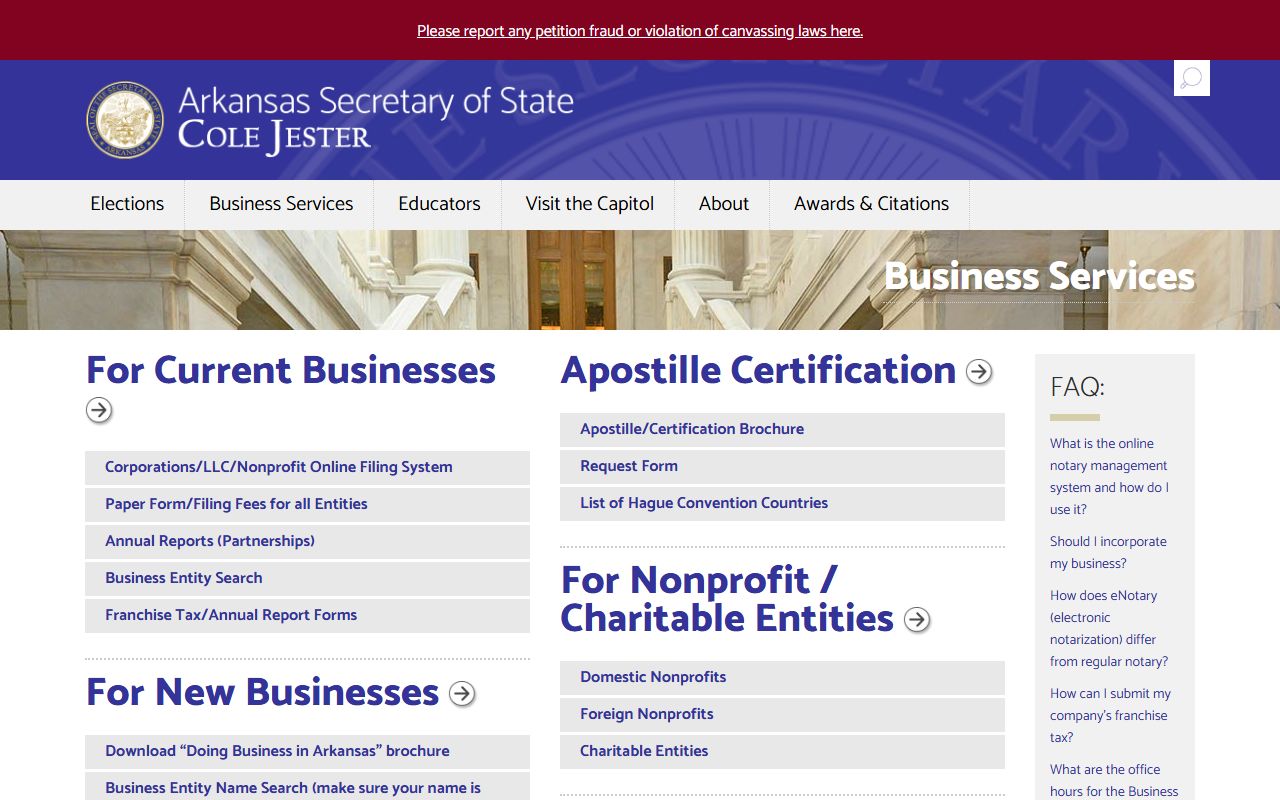
The same office at Room 256 in the State Capitol (501-682-1010) keeps the Notary Public Search, the UCC filing index, assumed name (DBA) records, and trademark filings. Business records go back to the early 1900s. UCC filings cover security interests in personal property and run for five years unless renewed. Filing fees are $15 for paper, $10 for electronic. A Residents Directory search that turns up a registered agent or a notary commission tells you who is doing business under what name in Arkansas.
Tip: Search the Notary Public database when you need to verify whether a notarized document was signed by an active Arkansas notary.
Property Records in the Arkansas Residents Directory
Property records tie names to addresses, which makes them one of the most-used parts of the Arkansas Residents Directory. The Assessor in each of the 75 counties keeps the parcel data. Real property is assessed at 20% of market value as of January 1st each year. Personal property runs through the same office and must be assessed by May 31st or take a 10% penalty. The Arkansas Department of Finance and Administration sets statewide rules and the Assessment Coordination Department oversees uniformity across all counties.
Property record cards show owner name, mailing address, parcel number, square footage, lot size, year built, and assessed value. Homestead exemptions trim $350 off the taxable value of a primary residence. Disabled veterans get extra cuts. Field appraisers walk properties to verify what is on the card. The whole assessment book turns over to the County Equalization Board on August 1st, and after that date the Equalization Board, not the Assessor, has the legal say to change values.
Land records sit with the Circuit Clerk acting as County Recorder. Deeds, mortgages, liens, easements, releases, assignments, and plat maps all get recorded there. Records get indexed by grantor and grantee names, which is how a title search runs. A name search through grantor/grantee indexes shows every property a resident has bought or sold in that county.
The Howard County public records page is one example of how the directory points users to indexed property data. Most counties offer something similar through their own websites, often through ActDataScout.com for parcel lookups.
The Arkansas Judiciary in the Residents Directory
The Arkansas Judiciary site at arcourts.gov rounds out the court side of the Residents Directory. Below the screen capture from that site, you can see the entry point used by lawyers, journalists, and people checking on a relative's case status. The Supreme Court and Court of Appeals both publish opinions, dockets, and case info there.
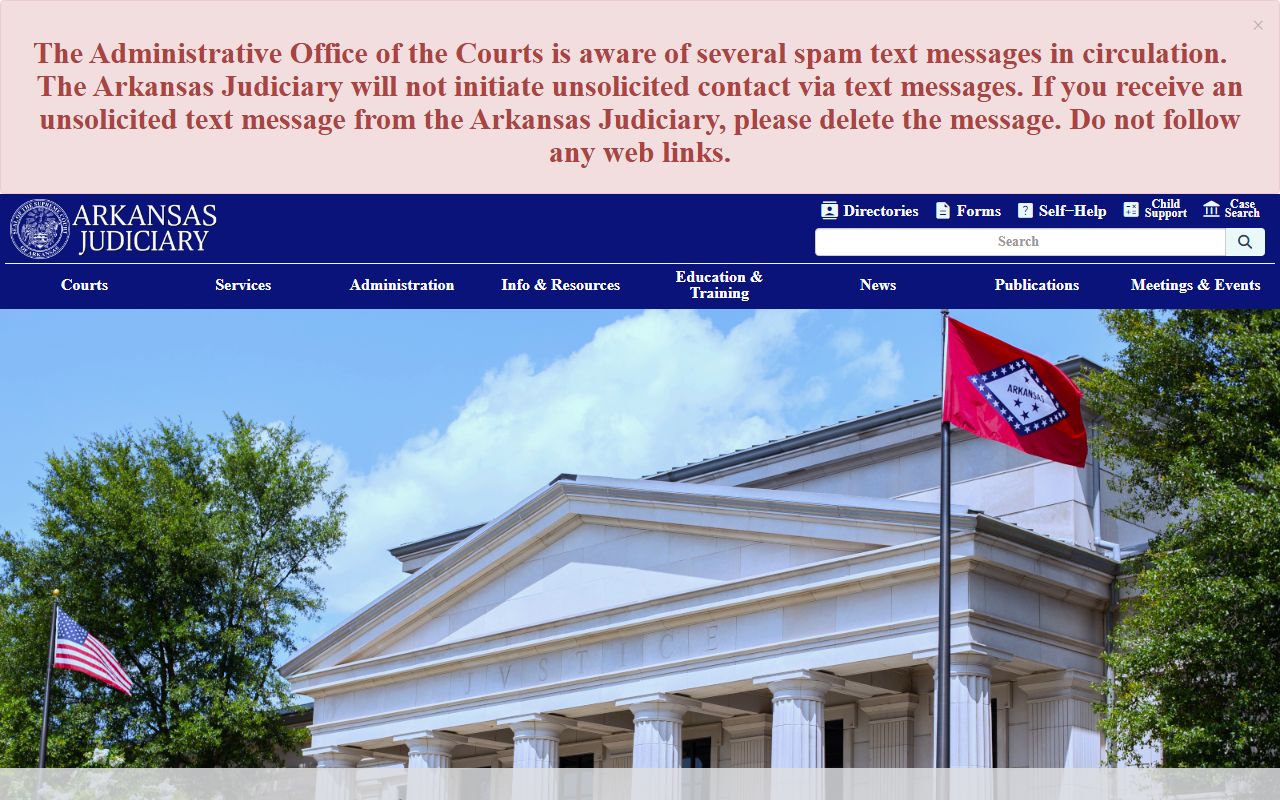
Oral arguments are live-streamed and stay archived on the site. The Clerk of the Courts handles document copy requests. The website also lists attorney discipline records and bar admission info, which is useful when you need to verify whether an attorney named in the directory is in good standing. The Administrative Office of the Courts keeps statewide stats on case filings and dispositions.
Public Records Laws Behind the Arkansas Residents Directory
The Arkansas Freedom of Information Act, codified through Act 152 of 1999, is the legal backbone of the Residents Directory. Most government records are presumed public unless a specific law shields them. The Act covers state and local agencies, including counties and cities. Agencies must respond to a written request within three business days, with extensions allowed for big requests. Fees can cover the actual cost of copies and staff time.
Some records sit outside the open-access rule. Personnel files (other than name, salary, and position), active law enforcement investigation files, medical records, adoption records, and records covered by privacy laws are exempt. The Arkansas Attorney General's office handles compliance guidance and fields complaints about denied requests. Courts have read the FOIA broadly in favor of public access, and violations can bring civil penalties and attorney fee awards.
The Arkansas General Assembly's official site hosts the full Arkansas Code and the Constitution of 1874. Title 26 covers Taxation, Title 27 covers Vital Statistics, and Title 16 covers Courts. The Bureau of Legislative Research keeps the site as the official source for state law. Users can search by keyword or browse by title and chapter.
Arkansas FOIA also requires open meetings of government bodies with advance notice. Executive sessions are limited to specific topics like personnel matters or litigation strategy. The same Act drives much of what shows up in the Arkansas Residents Directory: deeds, court files, voter rolls, marriage records, and arrest data are all open under the public-records framework.
Background Information in the Residents Directory
Background information is one of the most-asked-about parts of the Arkansas Residents Directory. The Arkansas State Police Identification Bureau runs the official Criminal Background Check (CBC) service through the system shown below.
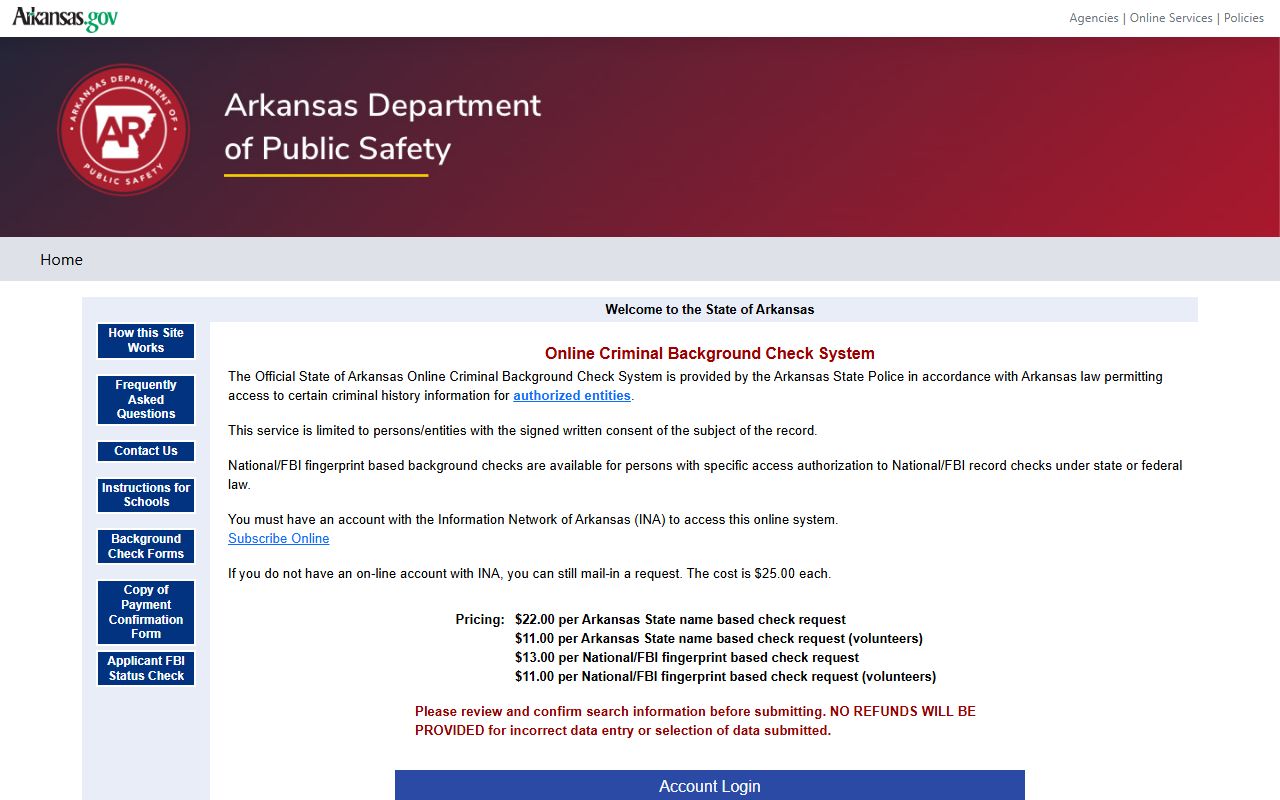
The system at cbc.ark.org reports felony and misdemeanor convictions, pending felony arrests within the past five years, and sex offender registry status (Levels 1 through 4). It does not show pending misdemeanors, dismissed cases, nolle prosequi outcomes, not-guilty verdicts, or traffic infractions like speeding or seat belt violations. Each Arkansas state check costs $22, with volunteer rates at $11. Fingerprint-based AFIS matching is used to link arrests, not just name matching, which cuts down on false hits when names are common.
The Arkansas Crime Information Center (ACIC) runs the state's central criminal-justice database and the sex offender hotline at (501) 682-2222. The online sex offender registry takes searches by name, address, city, or county. ACIC works around the clock and ties Arkansas data into the National Crime Information Center (NCIC). Levels 3 and 4 trigger community notification.
For a quick guide to what the CBC shows and what it doesn't, see the Arkansas State Police CBC FAQ page shown next.
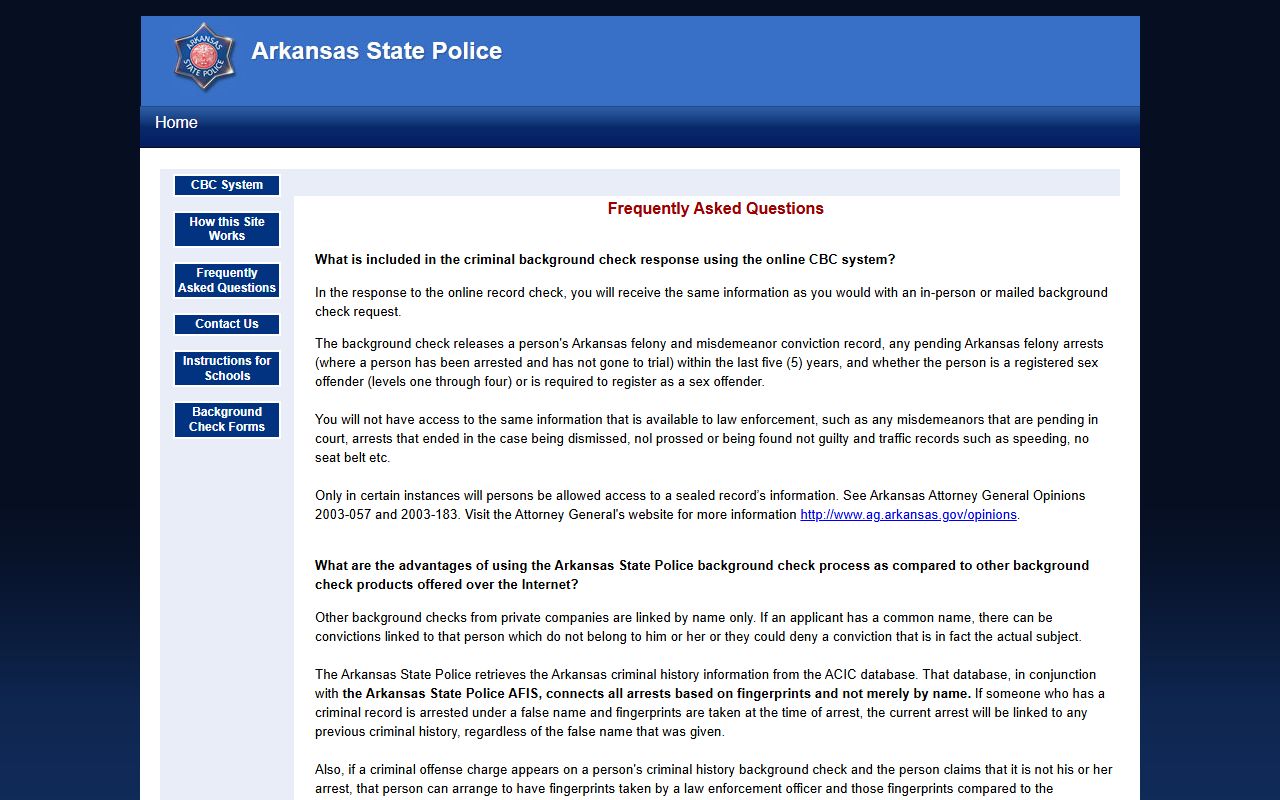
The FAQ covers fingerprint matching, fee structures, processing times (usually 2 to 5 business days for manual ASP-122 form requests), and what to do if a record looks wrong. Fingerprinting at no cost is available if you need to challenge a record that you say is not yours.
Voter Registration and the Arkansas Residents Directory
Voter rolls are part of the Arkansas Residents Directory under state law. The Secretary of State runs the Voter View tool, which lets people check their registration, find their polling place, and view sample ballots. County clerks keep the local rolls. Public voter file data covers name, address, date of birth, party affiliation, and voting history (which elections the voter took part in, not how they voted). Social Security numbers and driver's license numbers are kept private.
New registrations must be in 30 days before an election to count for that election. The system also lets a registered voter update their address within the same county. Voter registration cards arrive by mail and must be shown when voting. For research purposes, the voter file is a fast way to confirm whether a named Arkansas resident is registered, in what county, and at what address.
Note: Voter file data in the Residents Directory is public, but bulk requests usually need to go through the County Clerk under standard FOIA procedures.
Historical Records in the Arkansas Residents Directory
For older Arkansas residents and their ancestors, the Arkansas State Archives holds census records, military records, land grants, court records, and other historical documents going back to territorial days. The archives cover the Arkansas Territory (1819 to 1836), Confederate and Union military files, land office records, and governors' papers. County records sit on microfilm there as well, including deed indexes, court files, and probate records.
Research services are open by mail and email for people who can't visit in person. The Archives publish finding aids and research guides to help users navigate the collections. Genealogy researchers can use the Archives in tandem with current county records to build a multi-generation Residents Directory entry for a single family.
The Arkansas Commissioner of State Lands oversees tax-delinquent property and forfeited land sales, with records that show ownership history on parcels that ran into back-tax trouble. Tax-delinquent property goes through annual sales with a redemption window of two years for homestead and one year for non-homestead.
Common Searches in the Arkansas Residents Directory
Most users come to the Arkansas Residents Directory with a short list of needs. The same handful of search types come up again and again across all 75 counties. Picking the right starting point saves time.
Here are the searches that turn up most often in the directory:
- Name search for active and closed court cases through CourtConnect
- Property owner lookup through the county Assessor
- Marriage license verification through the County Clerk
- Inmate or recent arrest lookup through the Sheriff's office
- Voter registration and polling place check through Voter View
- Business owner lookup through the Secretary of State
- Sex offender registry search through ACIC
Each of these searches has its own intake form, fee, and turnaround time. The county and city pages on this site show you exactly which office to contact for each lookup. If a county doesn't run an online portal, the local Circuit Clerk or County Clerk will pull the record by phone or in person during regular hours.
Browse Arkansas Residents Directory by County
Each of the 75 Arkansas counties has its own page in this directory. Pick a county to find its Circuit Clerk, Assessor, Sheriff, and County Clerk plus links to local online resources.
Arkansas Residents Directory in Major Cities
Pick a city to find the local police records office, the county handling court filings for that town, and city clerk contact info.